
Rules Are(n't) for Suckers
Foreign corruption, development finance, and what "competitive advantage" really means

“Level the playing field” has been a constant refrain in development and U.S. foreign policy since at least 2014, when I first entered government. It means making sure that U.S. companies can compete fairly overseas. In the energy sector, this is a huge issue: developers and suppliers doing business in emerging markets face all kinds of challenges. And they want help competing against highly subsidized Chinese suppliers, or against firms in the habit of signing shady backroom deals.
But they want the playing field leveled up, not down. They want transparent procurement, clear and consistent regulation, and reduced political uncertainty. While some of them have personal stories of being asked for bribes over the years (sometimes subtly and sometimes right out in the open), I’ve never heard any of them–even in private conversation–argue that the U.S. should stop enforcing anti-bribery rules.
That’s why it’s so disturbing that President Trump signed an Executive Order pausing for 180 days the initiation of any new investigations or enforcement actions under the Foreign Corrupt Practices Act (FCPA). During this six-month hiatus, the administration will review existing cases and take action to “restore proper bounds” on the law’s enforcement.
President Trump has targeted the FCPA since his first term–claiming “the world is laughing at us” for enforcing it. This stance fits into a broader dog-eat-dog narrative that explains how his administration sees the world: everything is blatantly transactional, corruption is everywhere, and rules are for suckers. Any attempt to hold U.S. companies to high standards through laws like the FCPA is inherently stupid and self-sabotaging. You can see the same approach in their domestic politics.
As is often the case, there’s a grain of truth here. In some countries, bribery is widespread. And the US has been stricter than most countries about enforcing anti-corruption. But stepping back from the FCPA would be a huge blow to US companies and investment–especially for the types of geopolitically “strategic” projects (in mining and other crucial infrastructure) this administration says it wants to advance. At a time when private companies are poised to become even more central to how the U.S. government approaches international partnerships and diplomacy, this sends a very dangerous signal.
How big a threat is bribery, really?
First, what is the FCPA? Enacted back in 1977, it prohibits any U.S. person, U.S. company, or any company listed on a U.S. stock exchange from bribing foreign government officials to obtain or retain business in foreign markets. Penalties for violation include significant fines and prison time. Since becoming law, FCPA enforcement actions have been taken against some of the biggest companies in the world.
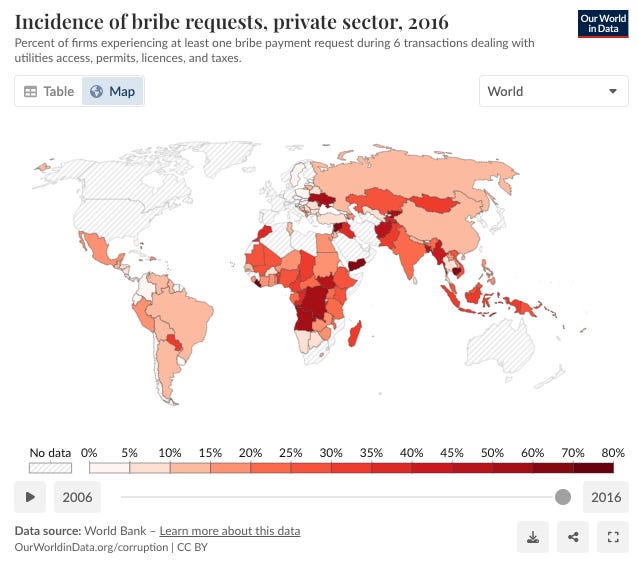
Bribery is (of course) real–but it’s not endemic everywhere. Our World in Data pulled World Bank Enterprise Surveys on the incidence of bribe requests. In some countries, bribery does appear extremely common: In Liberia, roughly 70% of firms experienced at least one bribe request during six transactions. In Cambodia, that figure was 64%--in the Democratic Republic of Congo it was 56%. But the incidence was quite low in other emerging markets: 11% in Senegal, 9% in Namibia, 8% in Botswana. Peter Sullivan, the managing director and head of public sector for Africa at Citi, said he only remembers a single instance of being asked for a payout in 20 years of doing business on the continent.
There is some truth to the assertion that the U.S. enforces anti-corruption rules more strictly than others. In 2022, Transparency International found that only two countries–the U.S. and Switzerland–actively enforce their anti-bribery laws. And the U.S. private sector has long critiqued FCPA enforcement, arguing that investigations can be lengthy and very expensive; the law’s jurisdictional reach is overly broad; and that aggressive enforcement makes U.S. businesses less competitive. (Though even the U.S. Chamber of Commerce recommended the law be clarified–not unenforced).
So is bribery a problem globally? In some countries, yes. Is the U.S. stricter than most other countries? Apparently, yes. Is the answer to lower our standards? No!
Five big risks to U.S. investment and diplomacy
I see five big risks to U.S. investment and national security if the Trump administration backs away from enforcing anti-bribery rules.
Normalizing corruption will only make it worse. Despite the stereotypical vision of poor countries as being rife with corruption, it’s not endemic everywhere. But if U.S. rhetoric or policy helps make corruption seem more like a natural (and unavoidable) economic transaction, it will only become more common and harder to tackle.
Relaxed enforcement will put American companies and individuals at increased risk. In any sensitive negotiation, it’s helpful to be able to blame a third party for your inability to concede. Robust enforcement of the FCPA gives U.S. companies a convenient out: they simply can’t engage in bribery or they’ll be prosecuted. Some private sector and advocacy groups have already raised concerns that this will simply put a target on companies’ backs, inviting more aggressive approaches from foreign governments and ultimately raising costs.
U.S. companies won’t win in a more corrupt world. Will U.S. companies thrive in a world where competitiveness is determined by the size of the payoff you’re willing to provide? Definitely not! Let’s look at a sampling of companies that have partnered with the U.S. government to invest in energy solutions in Africa. This is the list of Power Africa’s private sector partners. (*Unfortunately, this is a list from 2017. I can’t access updated information because USAID’s website has been pulled down…awesome). Yes, there are some major multinational corporations–but most of these are small companies, or even start-ups operating on shoestring budgets. There’s no way these companies would survive in a world where bribery becomes the norm. Who do you think has the resources to win a bribery bidding war–a U.S. company accountable to its shareholders, or a Chinese state-owned firm?
Anti-corruption will only get more important if this administration wants to make “strategic” investments in developing economies. The executive order specifically calls out the need to make U.S. companies competitive in “strategic” sectors, suggesting the administration might loosen enforcement in specific areas. But a strong stance on anti-corruption becomes more (not less!) important if the administration wants to do more in critical minerals and extractives, sectors known for their history of corruption and backroom dealing. Prosecutions under the FCPA have been disproportionately concentrated in certain sectors–especially in energy and extractives. Getting involved in mining operations around the world will already require the U.S. government to get comfortable with a lot more risk. It seems like an extremely inopportune time to ease anti-corruption efforts.
Corruption puts the U.S. government at risk too. The FCPA targets corruption between foreign governments and companies–but the USG could easily be a (hopefully unwitting) party to rotten transactions. Late last year, US prosecutors accused Gautam Adani, founder and chairman of the Adani Group, of bribing Indian officials in exchange for favorable terms on solar power contracts, projected to yield over $2 billion in profits. The year before, DFC had committed $500M to another Adani project: port infrastructure in Sri Lanka. Anytime the USG supports private commerce, it risks exposure to all kinds of shady characters. And it benefits from an aggressive investigation and enforcement mechanism.
The biggest leg up for U.S. companies is the foreign assistance that’s being rolled back
The executive order asserts that the global competitiveness of U.S. companies is “inextricably linked” with U.S. foreign policy. Fair enough. But it might surprise the DOGE team to know that ‘leveling the playing field’ for U.S. companies is already a major component of development assistance. Unfortunately, these are the same programs being targeted under the administration’s rollback of foreign aid. For instance:
The US Trade and Development Agency’s Global Procurement Initiative trains public officials in emerging markets on how to integrate life-cycle cost analysis and best value determination into procurement processes, making it more likely awards will go to U.S. companies with more expensive (but higher quality) technology.
The Commerce Department’s Commercial Law and Development Program partners with other countries to make procurement processes, laws, and regulations that impact businesses more transparent and fair.
And USAID funded transaction advisors under Power Africa that helped all quality companies (American and not) navigate African markets and access financial support.
Yes, supporting the U.S. private sector is a significant and valid part of US foreign policy and a strong US national security posture. But we do that best by making international markets as open, fair, and competitive as possible. That means retaining the experts working on these issues and building on programs like the Global Procurement Initiative up–not dismantling them.
It’s not clear yet what will happen as a result of this “review”. The FCPA remains a valid law until repealed by Congress–and other bribery laws remain in effect. But no matter what happens, U.S. policy on global corruption has huge (and growing) implications for development finance–especially as the Development Finance Corporation (DFC) becomes more central to our overall approach.